
US Market Update
- Monday, September 17, 2002
This analysis featured in the September 17, 2002 issue of the HGCA's MI Prospect, Volume 5, Number 6
Key points
US grain prices have risen significantly since early June, mainly as a result of poor US harvests and crop prospects, but also, increasingly for wheat, supply problems elsewhere and a tighter world supply/consumption balance. Demand, or more correctly consumption, prospects will be more important in determining price direction this autumn.
As the US is the largest exporter of wheat and the largest producer and exporter of feed grains, the US market is the most sensitive barometer of world grain market conditions. The dominance of the US market is formally recognized by its use for setting European Union import tariffs, although, with the re emergence of Black Sea ports as a source of grain for international markets after nearly 100 years, this situation may be changing.
The US market can at times appear a little parochial with weather conditions in Chicago, rather than the major grain growing areas of the US and elsewhere, seeming to preoccupy the local trade. Such diversions are, however, usually short lived.
The Chicago Board of Trade December futures contracts for corn and wheat are the bell whethers for new season crop prospects. By December US crops are harvested and markets reflect new season supply situations.
During the summer months when crop prospects are uncertain, US prices are seasonally volatility and a weather market "risk premium" often develops when weather forecasts appear to threatened crop developments. This is particularly the case for the maize market as close to half of world coarse grain production and rather more than half of world trade is grown in a relatively small region which is, as often as not, influenced by a single weather system.
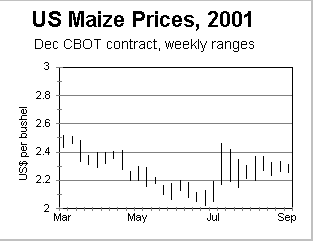
Last year was typical in this respect. In response to weather forecasts of an extended dry and hot period during July, which would have adversely affected crop prospects during the critical silking, seed fertilization, period, maize prices not only increased and but were more volatile than earlier in the season(Graph 1).
continueChart 1

continued
The weather, however, was not as detrimental as anticipated and prices settled down as the season progressed with the increasing certainty of favourable yields and a large harvest.
This summer's experience has been very different.
Wheat
Wheat prices drifted lower during the spring despite a widening drought situation across most of the winter wheat producing Western Plains. But since early June prices have risen increasingly rapidly with about 50 percent being added to wheat values in the process(Chart 2). Initially this was perhaps the result of the realization that it was too late for rain to provide any relief. But during July the deterioration of the US maize crop and the US spring and Canadian wheat crops maintained the momentum of the market with, more recently, unfavourable early Australian crop prospects adding to concerns.
continueChart 2


continued
But from this point on demand will start to play a more important role. The old saying that "short crop have long tails" reflects the reality that prices often tail off during the season following the kind of supply driven price increases of the last three months. Higher prices stifle consumption to levels below those initially anticipated by the market.
Against this wheat has only recently reached price ranges which were common place between 1988 and 1997. They may not, therefore, yet be a major deterrent to consumption. And further serious rationing of supplies globally is unlikely to occur while wheat is available from Black Sea ports at a substantial discount to US values. Even as things stand US exports are running ahead of year ago levels and forward commitments are only now beginning to tail off. The USDA most recent adjustment of its export projections for the season was upwards.
This, together with an increasingly tight world supply/consumption balance, seems to justify US wheat values above $4.00 per bushel, particularly if supplies of competitively priced wheat from Black Sea ports diminish. It is also evident that high quality hard red spring wheat will be in particularly short supply as following a drought during the summer, farmers on both sides of the Canada/US boarder have been faced with a wet harvest. The Canadian Wheat Board has recently even found it advisable to withdraw from the market while it assesses harvest results.
And even if lower quality wheats seem to be in better supply, with the tighter coarse grain supply situation, they will surely meet ready demand.
Maize
Maize prices have since the third week of June risen rather erratically by about 25 percent(Graph 2). It was at that time that, having improved during June, US corn crop condition began to deteriorate. During July it was a classic weather market with each successive weather forecast and report influencing prices one way or the other, but mostly higher as the crop sustained irreversible damage. Since then the weather has cooled, and rain has prevented further damage with prices now seeming to be moving sideways in a rather erratic manner.
The 30 million tonne cut in US maize production prospects in little over a month was dramatic in absolute terms and has created a projected global coarse grain supply/demand balance, in a historic context, as tight as that for wheat. The impact of this, however, has and may continue to be rather less than that of the wider influences on the wheat market. It is further evident that feed grain supplies are likely to be more easily rationed by price than wheat, particularly as uncertain global economic conditions may have a material impact on meat consumption upon which feed grain demand depends.
Soybeans
Soybean price increases have been more modest than those for wheat or corn, and limited to about 20 percent. While grown in the same region as corn and, therefore, subject to the same weather, the critical period for beans is August during pod filing by which time more broken weather had developed. It is also very evident that the dominant position of the US in world markets has been eroded over the last decade by the growth in exports from Brazil and Argentina.
David Walker
phone: 01603 705153
top of page